Every goalkeeper faces the same pressure — the shot, the crowd, the decision made in half a second with everyone watching. But stand behind ten different goalkeepers and you’ll see ten completely different games being played.
Three of the greatest to ever play the position built their careers on completely different philosophies. And each one maps to something real about how engineering managers lead.

Oliver Kahn commanded his box. Aggressive, vocal, physically imposing. He told his defenders exactly where to stand, exactly when to press, exactly what was unacceptable. His area was organized because he organized it through sheer force of presence. Defenders didn’t need to think much. Kahn was thinking for them, loudly, in real time.
As a manager, this is the directive mode at its most natural. It works, especially in crisis, especially with junior teams that need structure. A production incident hits and someone needs to say exactly what to check, in what order, right now. That’s Kahn. But it has a cost: the team becomes dependent on your judgment. When you’re not in the room, the quality of decisions drops.
Gianluigi Buffon barely looked like he was working. His genius was positional. He read the game so well that he was always in the right place before the shot came. No drama. No spectacular dives when a calm step to the left would do. He made goalkeeping look effortless because the hard work was invisible: anticipation, reading patterns, being prepared before the danger arrived.
As a manager, this is the anticipatory style. You don’t command. You position. You read the organization, sense where problems are forming, and quietly adjust before they escalate. A well-structured meeting with a clear agenda where everyone knows their part before they walk in. That’s Buffon. Your team feels stable but can’t always articulate why. The cost: you can look passive to people who mistake calm for disengagement.
Jerzy Dudek broke the rules. Istanbul 2005. Liverpool down 3–0 at halftime against AC Milan in the Champions League final. The comeback happens, and then the penalty shootout. Dudek stands on the line doing something no coaching manual would ever recommend: wobbling his legs, waving his arms, dancing. It’s absurd. It’s distracting. And it works. Shevchenko, one of the best strikers in the world, misses the deciding penalty. Liverpool win the European Cup.
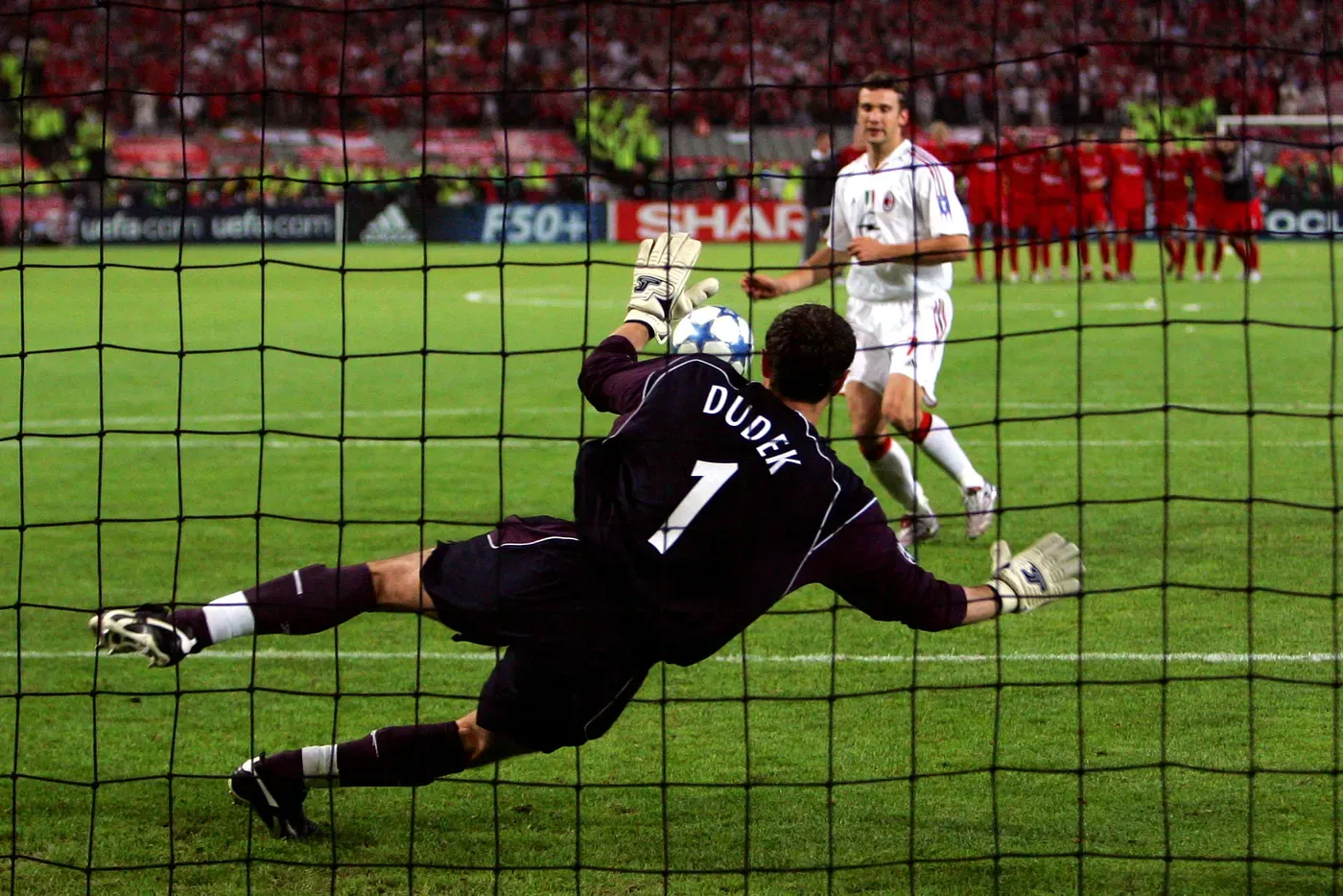
Footage and story: Jerzy Dudek, penalties, Istanbul 2005
Dudek’s genius wasn’t athleticism or positioning. It was reading the moment and improvising a response that no one, including the opposition, expected. The textbook play wouldn’t have saved that shootout. The unorthodox one did.
As a manager, this is the adaptive style. You break pattern when the situation demands it. When process isn’t working, you don’t double down on process. You try something nobody’s tried. When a conversation is stuck in a loop, you reframe it from an angle no one anticipated.
I’m a Dudek-style manager. Not because I planned it, but because it’s where my instincts live. When a design review stalls on the same feedback loop for the third sprint, I don’t escalate through the standard chain. I’ll pull the designer and engineer into an unstructured half-hour session with no agenda and no Jira ticket, and we’ll figure it out by talking. When a cross-timezone alignment problem can’t be solved with more meetings, I’ll restructure the work so the dependency disappears entirely instead of trying to manage it.
The pattern is the same each time: when the standard play isn't working, stop running it.
This style has costs. It can look chaotic to people who value consistency. It depends on reading the moment correctly. Improvise at the wrong time and you look reckless, not creative.
But here’s what management training almost never tells you: all three styles work. Kahn won a World Cup. Buffon defined an era. Dudek won a Champions League final that had no business being won.
The problem is that training implicitly teaches you to be Buffon. Calm, positional, read the room. Or sometimes Kahn. Direct, commanding, own the decision. Almost nobody teaches you that Dudek is a legitimate option. That reading the moment and breaking the pattern is a valid management style, not a failure of discipline.
The real skill isn't picking the right style. It's knowing which one the moment requires.